
Kontinuierliche Trennung von Enantiomeren
Kontinuierliche Trennung von Enantiomeren mit Hilfe von selektiver Kristallisation Continuous Separation of Enantiomers by Preferential Crystallization
Kontinuierliche Trennung von Enantiomeren mit Hilfe von selektiver Kristallisation
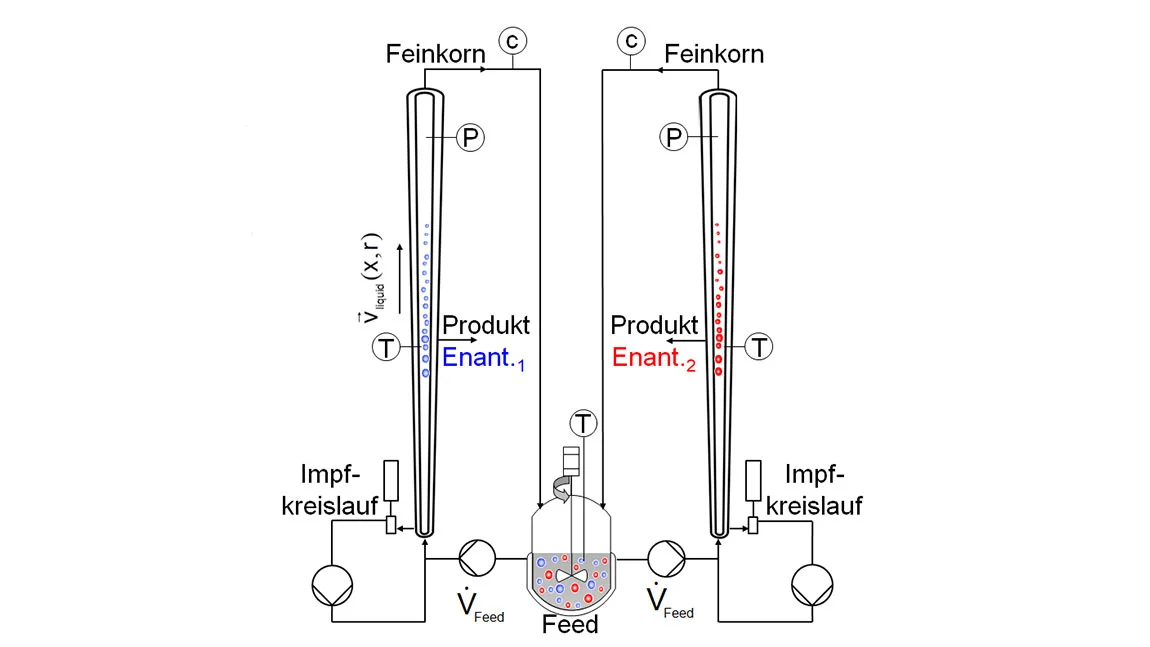
Continuous Separation of Enantiomers by Preferential Crystallization Was sind Enantiomere? Enantiomere sind Moleküle, die in zwei Varianten auftreten, die sich zueinander verhalten wie rechte und linke Hand oder wie Bild und Spiegelbild. Enantiomere kommen sehr häufig in Lebensmitteln oder als Wirkstoffe in Medikamenten vor. Wozu Trennung von Enantiomeren? Enantiomer und Gegenenantiomer haben meist völlig unterschiedliche Effekte auf biologische Organismen oder den menschlichen Körper. Bei der chemischen Synthese entsteht aber oft ein 50/50 %-Gemisch beider Enantiomere, das dann in seine beiden Bestandteile aufgetrennt werden muss. Da Enantiomer und Gegenenantiomer identische physikalische Eigenschaften haben, ist die Trennaufgabe anspruchsvoll. Kontinuierliche Enantiomerentrennung durch selektive Kristallisation ... ... ist ein neuartiger Prozess, der die Trennung einer großen Klasse von Enantiomeren (sogenannten Agglomeraten) gestattet. Eine geeignete Kopplung zweier Wirbelschichtkristallisatoren ermöglicht die Gewinnung beider Enantiomere in kristalliner Form mit hoher Reinheit. Der Prozess wird im Rahmen eines von der Deutschen Forschungsgemeinschaft DFG geförderten Verbundprojekts untersucht. Wozu mathematische Modellierung? Um die gewünschte Funktionalität zu erreichen, müssen die Betriebsbedingungen (z.B. Durchflussraten) und die Kristallisatorgeometrie sorgfältig gewählt werden. Im Projekt werden mathematische Modelle entwickelt, die über Computersimulationen eine optimale Wahl der Betriebsparameter gestatten. ---- Continuous Separation of Enantiomers by Selective Crystallization What are enantiomers? Enantiomers are molecules found in two variants that are mirror images of each other, like left hand and right hand. They occur frequently as food components or as pharmaceutical agents. Why separation of enantiomers? Enantiomer and counter-enantiomer may have completely different effects on biological organisms or the human body. As chemical synthesis usually produces a 50/50 % mixture of both enantiomers, the mixture has to be separated into its two components. The separation task is challenging, because enantiomer and counter-enantiomer have identical physical and chemical properties in an achiral environment. Continuous Separation of Enantiomers by Selective Crystallization ... ... is a novel process that allows for the separation of a large class of enantiomers (so-called agglomerates). By coupling two fluidized bed crystallizers in a suitable way, both enantiomers can be recovered in pure crystalline form from a racemic mixture. The process is studied in a joint research project funded by the German Science Foundation DFG. Why mathematical modeling? The operation window of the considered process is quite small; choosing optimal operation conditions by experimental studies is tedious. Therefore, as a key objective of the project mathematical models are developed for the process design. Based on these models, computer simulations and numerical optimizations determine optimal operation conditions and optimal crystallizer geometries for maximum product purity or maximum yield.
- Laufzeit: 07.2017 - 07.2019
- Budget: 162.400,00 EURO
- Förderer:
- Prof. Dr.-Ing. Andreas Seidel-Morgenstern, Max-Planck-Institut für Dynamik komplexer technischer Systeme, Magdeburg
- PD Dr.-Ing. Gabor Janiga, Lehrstuhl für Strömungsmechanik und Strömungstechnik, Otto-von-Guericke-Universität, Magdeburg
Prof. Dr.-Ing. habil. Michael Mangold
Projektverantwortlicher1-126